
El Nido Accessible Travel Guide 2026: Tips for Travellers with Disabilities
El Nido is an honest destination for accessible travel — which means being upfront about both the challenges and the genuine possibilities. The town’s rough roads, boat-heavy transport, and rugged island terrain make parts of the experience difficult for travellers with mobility limitations. But with careful planning, the right accommodation, and flexible expectations, El Nido is achievable and deeply rewarding for travellers with a range of disabilities. This guide gives you a realistic picture.
Honest Assessment: What’s Challenging
- Roads: El Nido town has uneven concrete paths, open drains, and unpaved sections — wheelchair navigation requires a sturdy manual or powered chair and a companion for assistance on rough stretches
- Boats: Bangka outriggers require stepping over the side and onto a narrow hull — difficult or impossible for many wheelchair users without significant assistance. Transfer from wheelchair to boat deck is physically demanding.
- Island beaches: Most tour stop beaches are accessed across sand or rocks — no paved paths, no ramps, no beach wheelchairs available for hire
- Lagoons: The Big Lagoon kayak entry requires paddling a kayak — not accessible for most wheelchair users independently
- Taraw Cliff hike: Not accessible for anyone with mobility limitations
What IS Accessible or Adaptable
Las Cabañas Beach
The most accessible beach in El Nido — reached by tricycle (sidecar configuration accommodates a folding wheelchair), with a relatively firm sand surface at the beach entrance. The beachfront bar is at ground level. The cable car (₱250) has a seated gondola that can accommodate most wheelchair users with transfer assistance from a companion.
El Nido Town Waterfront
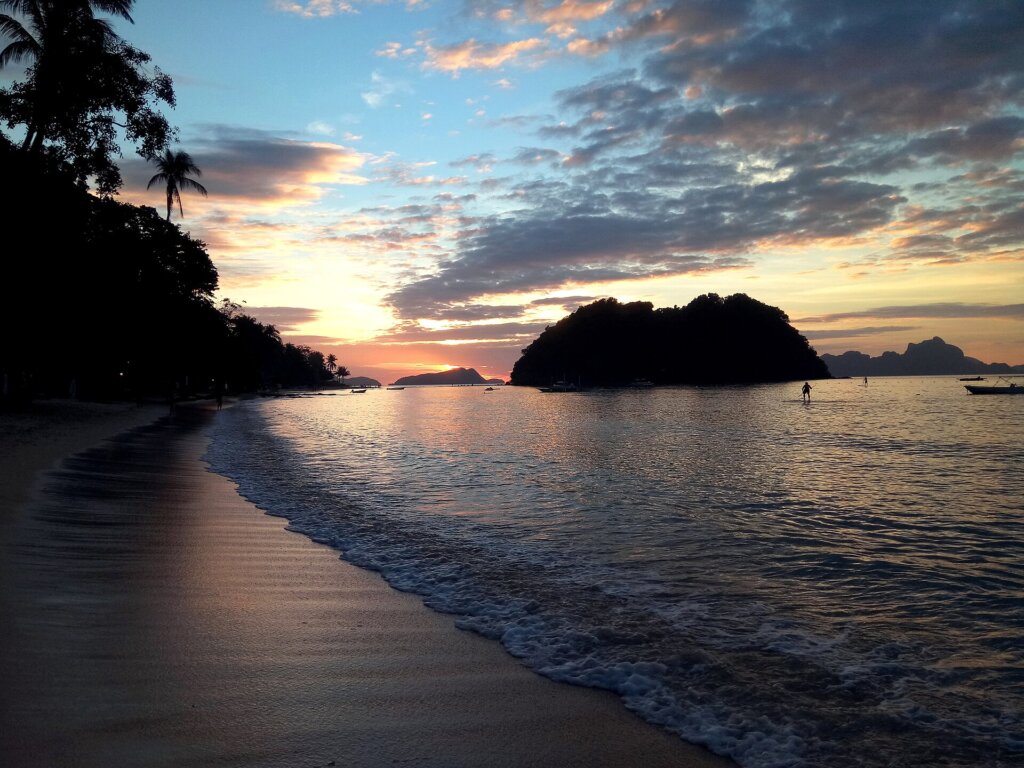
The main beach road along Corong-Corong is the most even surface in town — suitable for wheelchair or mobility aid use. The beach itself is accessible to the water’s edge for swimming (shallow, calm, sandy). Sunset views are excellent from the waterfront without needing to go anywhere else.
Island Hopping (With Preparation)
Island hopping is possible for many mobility-limited travellers with:
- A private charter (not shared tour) — the captain and crew can provide significant physical transfer assistance, and the schedule can be adjusted for pace
- Companion assistance for boat boarding/disembarking
- Beach wheelchair (bring your own — no rental available in El Nido)
- Focus on calmer, sandy-entry beaches (Seven Commando, Payong-Payong) rather than rocky entries (Small Lagoon, Hidden Beach)
Several travellers with paraplegia and lower-limb disabilities have successfully completed modified island-hopping tours with strong companion support. Communication with the charter captain in advance about assistance needs is essential.
Snorkelling
Travellers with upper-body mobility and who can float comfortably can snorkel at most tour stops — life jackets provide sufficient buoyancy for non-swimmers or those with limited leg mobility. Some operators have swim platforms that assist with water entry; ask specifically when booking.
Makinit Hot Springs
The 20-minute walk from the road to the springs is on a flat path — manageable for mobility aids on a dry day. The springs themselves require lowering into a natural pool (companion assistance needed); once in, the experience is fully accessible.
Accessible Accommodation
El Nido has no accommodation that fully meets international disability accessibility standards. However, some properties are more practical than others:
- Ground-floor rooms: Request explicitly — most guesthouses are multi-storey with no lift. Ask for a ground-floor room with en-suite bathroom before booking.
- El Nido Cove Resort: Has a relatively flat campus, pool with steps (no ramp), and ground-floor room options. Best mid-range choice for mobility-limited travellers.
- Island resorts (Pangulasian, Miniloc): The all-inclusive island resorts have stilted or tiered layouts — discuss specific needs directly with the resort before booking as walkway configurations vary.
- Wider doorframe guesthouses: Ask hosts about doorframe widths (standard in older Philippine guesthouses is 70–75cm; wider doors are available in some newer builds).
Travellers with Visual or Hearing Impairments
- Visual impairment: El Nido town is small enough to navigate with a cane and a companion’s verbal guidance. Guided island-hopping tours are fully accessible — guides describe the scenery and assist with boat boarding. Tactile experiences (touching limestone, feeling the lagoon water temperature gradient) are profound for visually impaired visitors.
- Hearing impairment: Tour guides can adapt with written communication or gesture for key safety instructions. The visual experience of El Nido is fully accessible.
Planning Resources
- Contact your accommodation directly by email before booking to explain your specific needs — Filipino hospitality culture means staff will make genuine efforts to accommodate when asked in advance
- The Disabled Travelers Philippines guide provides broader country-level context
- The AccessibleGo platform lists some accessible Philippines accommodation options
- For transport to El Nido, the Puerto Princesa van service can accommodate folding wheelchairs in the luggage area — confirm with your operator when booking
For full trip planning see our transport guide, best resorts guide, and 25 essential travel tips. El Nido’s beauty is worth every bit of extra planning it takes to get there.