

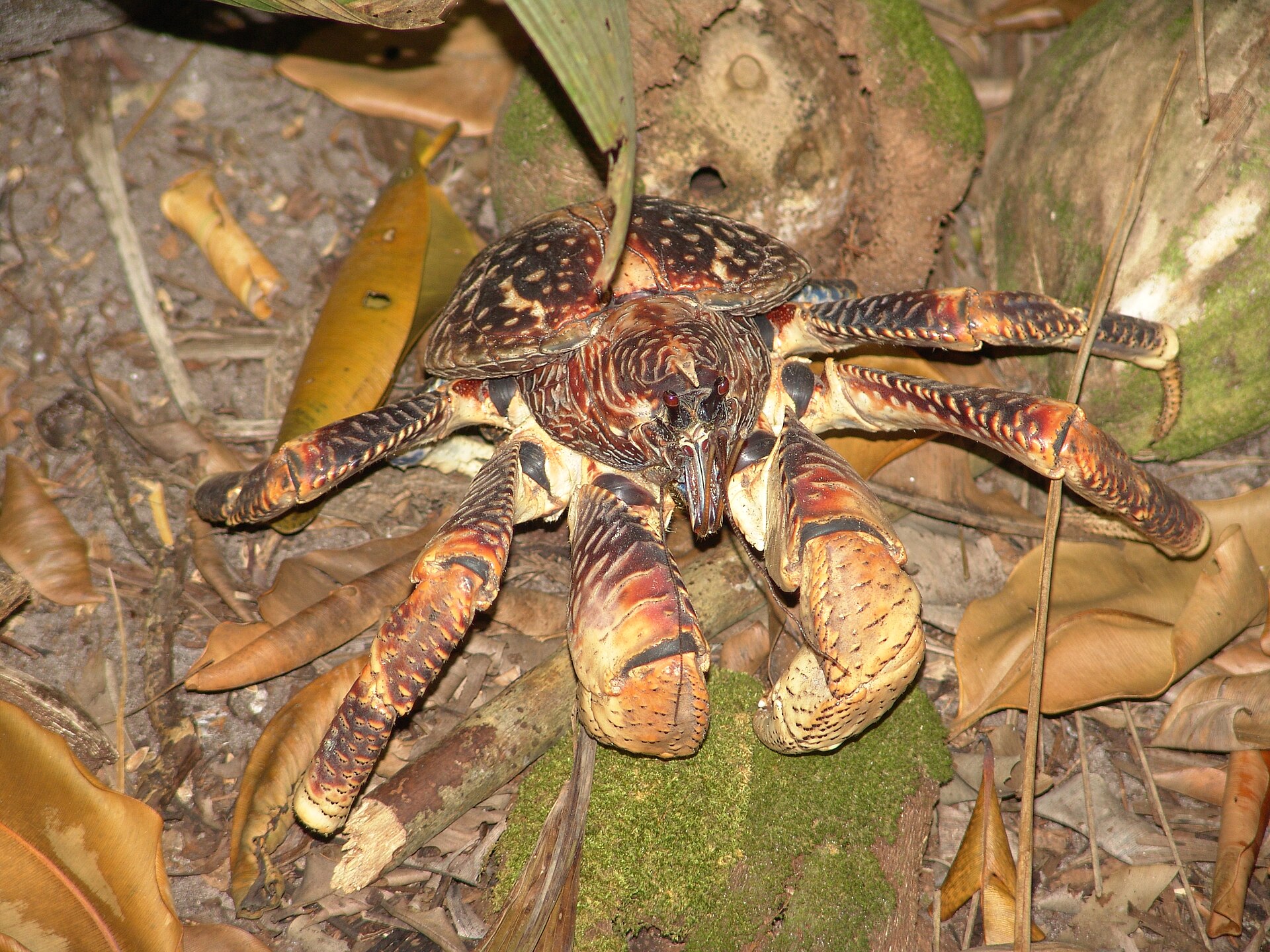
Walk past enough seafood displays in northern Palawan and sooner or later someone may offer you a giant, purple-blue crab with claws the size of a fist: the coconut crab, known locally in parts of Palawan as tatus. It is the largest land-living arthropod on Earth, it can live for decades, and its numbers have fallen sharply across the Indo-Pacific. This guide focuses on coconut crabs specifically for travelers in El Nido who want to enjoy local seafood responsibly — why you should not eat or buy them, what the law says, how to see one in the wild without harming it, and which crabs to order instead.
The angle is simple and practical: a short, evidence-based explainer you can read before dinner, plus a side-by-side comparison of the crabs you are most likely to see on El Nido menus. We avoid naming individual restaurants; the point is to know what to ask, not to shame anyone.
- Meet the Coconut Crab (Birgus latro)
- Why Coconut Crab Is a Conservation Concern
- What the Law Says in the Philippines and Palawan
- Crabs on El Nido Menus: What to Order Instead
- Seeing Coconut Crabs in the Wild, Respectfully
- How to Spot Coconut Crab on a Menu or Tour
- Supporting Conservation as a Visitor
- Frequently Asked Questions
Meet the Coconut Crab (Birgus latro)
The coconut crab is a giant terrestrial hermit crab. Juveniles carry snail shells like their smaller cousins, but adults harden their own abdomen and abandon shells entirely. Large males can weigh around four kilograms with a leg span close to a metre, and their claws produce one of the strongest pinching forces measured in any crustacean.
Despite the name, coconuts are only part of the diet. Coconut crabs scavenge fruit, seeds, carrion and almost anything edible on the forest floor, mostly at night. They live in coastal forest and limestone areas on islands, hiding in burrows or rock crevices during the day.
The crucial biological fact is how slowly they grow. Coconut crabs take several years to reach sexual maturity and may live for many decades. Females release eggs into the sea, larvae drift as plankton for weeks, and only a tiny fraction survive to crawl back onto land. A species built like that cannot withstand steady harvesting of large adults.
Quick Field Identification
Adult coconut crabs are hard to confuse with anything else. Look for a heavy, rounded body in shades ranging from orange-red to deep violet-blue, massive unequal claws, long walking legs and a soft-looking, tucked-under abdomen. They move slowly and deliberately on land, often climbing tree trunks or rocks. Smaller land hermit crabs, which are common on El Nido beaches at dusk, still carry shells; if the crab is shell-less and the size of a dinner plate, it is almost certainly a coconut crab.
Why Coconut Crab Is a Conservation Concern
The IUCN Red List classifies Birgus latro as Vulnerable. The main pressures are the same across its range:
- Over-harvesting for food and the restaurant trade, which targets the largest breeding adults first.
- Habitat loss as coastal forest is cleared for resorts, roads and farms.
- Easy capture: they are slow on the ground, active at predictable times and drawn to bait.
- Tourism demand, where a “once-in-a-lifetime” crab dinner creates an incentive to catch more.
On many small islands across the Pacific and Indian Oceans, coconut crabs have already disappeared from places where people live. The remote islets of Palawan remain one of the places they can still be found, which is exactly why visitor choices in places like El Nido matter.
There is also a ripple effect. Coconut crabs disperse seeds and recycle nutrients on island forest floors, and they help keep populations of rats and other scavengers in check by competing for food. Removing them changes how small-island ecosystems work, even if the change is not obvious to a day visitor. Researchers have used coconut crabs as an indicator species: where they are still common, island habitats tend to be in better shape overall.
What the Law Says in the Philippines and Palawan
The Philippines regulates the collection and trade of wildlife under the Wildlife Resources Conservation and Protection Act (Republic Act 9147), administered nationally by the DENR Biodiversity Management Bureau. In Palawan, the Palawan Council for Sustainable Development also issues rules and permits for wildlife under the Strategic Environmental Plan for Palawan. Coconut crab appears on Philippine lists of threatened species, and collecting or trading it without the proper permit is illegal.
El Nido is additionally covered by the El Nido–Taytay Managed Resource Protected Area, where extraction of wildlife is restricted. Penalties under national wildlife law can include fines and imprisonment, and they apply to buyers and transporters, not only to collectors.
Laws and lists are updated periodically, so treat this as a general overview, not legal advice. The simple rule for travelers: do not buy, eat, transport or keep coconut crabs, and do not accept one as a “gift” on an island tour.
Crabs on El Nido Menus: What to Order Instead
Good news for seafood lovers: El Nido has plenty of crab that does not carry the same problems. Use this table as a quick menu guide, and pair it with our best seafood and kinilaw spots in El Nido.
| Crab | Local name | Status for visitors | Notes |
|---|---|---|---|
| Coconut crab | Tatus / umang | Avoid — threatened, permit-regulated | Slow to mature; often illegally sourced |
| Mud crab | Alimango | Widely served; ask about size | Often farmed or caught in mangroves; skip undersized or egg-bearing females |
| Blue swimmer crab | Alimasag | Common and affordable | Great in garlic-butter or coconut milk dishes |
| Spiny lobster | Banagan | Order with care | Avoid small or berried (egg-carrying) lobsters |
| Slipper lobster | Pitik-pitik | Order with care | Same size and egg rules apply |
At a paluto setup where you buy seafood at the market and have it cooked, you have even more control over what you choose; see our El Nido paluto guide.
Seeing Coconut Crabs in the Wild, Respectfully
Encountering a coconut crab in the forest at night is a genuine wildlife highlight. If you are lucky enough to see one on a remote island campsite or a jungle trail:
- Keep a respectful distance — at least a couple of metres. Those claws can cause serious injury.
- Use a red or dimmed torch; do not blast it with bright light or a phone flash at close range.
- Never pick it up, feed it or move it for a photo.
- Do not leave food scraps around campsites, which draw crabs toward people and dogs.
- Report sightings of captured crabs being sold to your guide or the protected-area office.
The same etiquette applies to other wildlife you may meet on tours; our guide to cave wildlife etiquette covers swiftlets and bats.
How to Spot Coconut Crab on a Menu or Tour
Coconut crab is rarely listed with its English name. Watch for words like “tatus,” “king crab,” “land crab,” “special crab,” or a very high per-kilo price for a crab that is described as coming from the islands. On some private tours, crew may offer to “source” one for a beach barbecue.
A polite, clear response works best: “Salamat, pero hindi po — that crab is protected.” Most local operators know the rules, and many are proud of conservation efforts. Choosing a responsible operator helps; our list of eco-friendly tour operators in El Nido explains what to look for.
A note on food safety too: coconut crabs eat whatever they find, and there are documented cases worldwide of people falling ill after eating crabs that had fed on toxic plants. That is another reason to give them a miss.
If you are traveling with children, coconut crabs are a fantastic way to start a conversation about wildlife protection. A photo from a respectful distance, followed by a quick look at why the animal is protected, tends to stick with kids far longer than a lecture. Many island-hopping guides are happy to share local stories about tatus and how the islands have changed over the years — ask them.
Supporting Conservation as a Visitor
Your influence as a traveler is bigger than it looks. Demand drives supply, and a steady stream of visitors saying “no” changes what restaurants bother to source. A few easy actions:
- Pay your Eco-Tourism Development Fee; it supports management of the protected area.
- Leave reviews that praise restaurants for sustainable seafood choices.
- Choose island-hopping and camping operators with clear wildlife policies.
- Learn about the wider marine ecosystem through our El Nido coral conservation guide.
- Share what you have learned with fellow travelers — many simply do not know.
El Nido’s reputation rests on its wild places. Keeping giants like the coconut crab on its islands, rather than on its plates, is part of what will keep it special for the next generation of visitors.
Frequently Asked Questions
Is it legal to eat coconut crab in El Nido?
Coconut crab is listed among threatened species in the Philippines, and collecting or trading it without a permit is illegal under national wildlife law and Palawan regulations. Visitors should not buy or eat it.
Why are coconut crabs endangered?
They grow slowly, take years to mature and are easy to catch, so harvesting large adults for food quickly depletes populations. The IUCN Red List classifies the species as Vulnerable.
What is the local name for coconut crab in Palawan?
It is commonly called tatus in Palawan, and sometimes umang. On menus it may be disguised as king crab, land crab or special crab.
Which crab is sustainable to eat in El Nido?
Blue swimmer crab (alimasag) and mud crab (alimango) are widely available. Ask for full-size crabs and avoid females carrying eggs.
Can I see coconut crabs on an El Nido tour?
Sometimes, mostly at night on remote islands or forested campsites. Keep your distance, use dim light and never handle or feed them.