
Nobody warns you about this one. You arrive in El Nido, settle into a room, and at some point between mid-afternoon and midnight the air conditioning stops, the fans die and the whole street goes quiet in a way that is briefly unnerving. This is a brownout, it is entirely normal here, and it will probably happen more than once during your stay. This guide focuses on power interruptions specifically for visitors staying in El Nido for a few days — what causes them, when they cluster, what your accommodation is and is not likely to do about it, and the small number of preparations that make the difference between an inconvenience and a ruined evening.
- Why El Nido Loses Power So Often
- When They Happen and How Long They Last
- What Your Accommodation Will Actually Do
- What Actually Gets Disrupted
- What Does Not Get Disrupted
- How to Prepare, Realistically
- How to Find Out What Is Happening
- Turning It Into a Non-Event
- Is It Getting Better?
- Frequently Asked Questions
Why El Nido Loses Power So Often
The short version: El Nido is not connected to the main Luzon electricity grid. Palawan runs on its own isolated systems, and northern Palawan in particular depends heavily on local diesel generation distributed by a regional electric cooperative. That architecture has three consequences that visitors feel directly.
First, there is very little redundancy. When a generating unit goes offline for maintenance or fault, there is no large interconnected grid to draw replacement power from, so load has to be shed — meaning somebody’s lights go out. Second, capacity has not kept pace with tourism growth. El Nido’s demand has multiplied over a decade of resort construction, and generation and distribution investment has lagged. Third, the distribution network itself is exposed overhead wiring in a typhoon belt, so weather damage is routine.
Filipinos call a power cut a brownout regardless of whether it is a partial voltage drop or a total outage, which confuses visitors who expect the word to mean dimming rather than darkness. In practice, brownout means the power is off.
When They Happen and How Long They Last
Interruptions fall into recognisable categories, and knowing which one you are experiencing tells you roughly how long to wait.
| Type | Typical duration | What it feels like |
|---|---|---|
| Scheduled maintenance outage | 4–8 hours, daytime | Announced in advance, often on a weekday, whole areas at once |
| Load-shedding rotation | 1–4 hours | Unannounced, clusters in late afternoon and evening peak |
| Fault or equipment failure | 30 minutes to several hours | Sudden, unpredictable, often localised to a few streets |
| Storm-related damage | Several hours to days | Follows heavy wind or rain; the long ones |
| Brief flicker or dip | Seconds | Lights dim, devices reboot, air conditioning restarts |
The pattern most visitors notice is a cluster around the evening demand peak, roughly six to ten at night, when every restaurant, bar and guesthouse in town is drawing at once. The other cluster is the long scheduled daytime outage, which is genuinely better for you — if you are out on a boat all day, a maintenance outage is invisible.
Seasonally, the storm-driven long outages track the typhoon season and the southwest monsoon. The PAGASA tropical cyclone bulletins are the practical early warning: if a system is tracking anywhere near Palawan, expect interruptions and plan around them.
What Your Accommodation Will Actually Do
This is the single most useful thing to understand, and it varies enormously by price bracket. Generator coverage is the real dividing line between accommodation tiers in El Nido — far more meaningful than thread count or a pool.
Upper-tier resorts, particularly in the Lio enclave and the island properties, generally run full backup generation that cuts in within seconds. You may notice a brief flicker and nothing else. Mid-range hotels often have partial generator coverage — corridors, reception, sometimes fans but not air conditioning. Budget guesthouses and hostels frequently have no generator at all, or a small one that runs lights only, and some run it for limited hours to control diesel cost.
Ask this directly when you book, in these words: does the property have a generator, and does it power the air conditioning in the rooms? A vague yes to the first question frequently conceals a no to the second. Our overview of where to stay across El Nido town, Corong-Corong and Nacpan is worth reading with this in mind, because the areas differ in how well served they are.
What Actually Gets Disrupted
Air conditioning is the obvious one, and in a hot humid climate it is not trivial — a room that has been cooled will be uncomfortable within an hour of the power going. A room with a decent cross-breeze and a balcony is worth more here than in most destinations, precisely because it remains habitable.
Internet and mobile data degrade too. Cell towers have battery backup but it is finite, and guesthouse wifi routers simply stop. During a long outage, connectivity in town can become patchy to non-existent, which matters if you are working. Our SIM card and connectivity guide covers what coverage is like at the best of times, and working remotely from El Nido addresses how to build a schedule around the unreliability.
ATMs go offline, which compounds an existing problem — El Nido’s cash machines are unreliable at the best of times. Card payment terminals in restaurants also stop working, so an outage in the evening can leave you unable to pay for dinner electronically. Carrying enough cash to cover a day or two is genuinely prudent here, as our notes on ATMs and cash explain.
Restaurants mostly cope. The ones with wood-fired or gas kitchens keep cooking by candlelight and it becomes rather pleasant. Places relying on electric equipment may close early. Bars usually carry on.
What Does Not Get Disrupted
Worth stating plainly, because people worry unnecessarily: boat tours are unaffected. Island hopping runs on outboard motors and does not care about the town’s grid. Water supply usually continues, though properties relying on electric pumps to fill roof tanks can run low during a very long outage. Flights and ferries operate normally, since both airports and ports have their own backup generation.
How to Prepare, Realistically
The preparation list is short and cheap. A power bank is the single highest-value item — a 10,000mAh unit will recharge a phone two or three times and costs very little. Charge it, and your phone, whenever power is available rather than waiting until you need to; treating every powered hour as an opportunity to top up is the whole trick.
A small torch or headlamp beats a phone light, saves your battery, and is useful on stairs and unlit paths. Many guesthouses provide candles but not reliably. Keep offline maps and any booking confirmations downloaded to your device rather than trusting that you can pull them up when needed. And keep enough cash on hand to eat and get around for forty-eight hours.
If you use a CPAP machine or refrigerated medication, do not improvise. Book accommodation with confirmed full generator backup and tell the property in advance — most will accommodate the request if they know, and cannot if they do not. Our guide to plugs, voltage and charging in El Nido covers the technical side, including the socket types and voltage you will encounter.
How to Find Out What Is Happening
When the power goes, the instinct is to call reception, and that is not a bad first move — staff usually know whether it is the whole town or just the building, and whether an outage was announced. But the more reliable source is the regional electric cooperative’s own social media page, which is where scheduled maintenance notices and fault updates are posted in practice. Filipino utilities communicate through Facebook far more actively than through their websites, and locals check there first.
A useful piece of local knowledge: if the street lights are out too, it is a grid-wide interruption and will likely last a while. If your building is dark but the street is lit, it is your property’s own problem — a tripped breaker or an unpaid meter — and reception can usually fix it in minutes. Learning to make that distinction saves a lot of pointless waiting.
Turning It Into a Non-Event
The travellers who barely notice brownouts are not luckier, they have just built slightly different habits. They charge devices opportunistically rather than overnight. They choose rooms with natural ventilation and a balcony over sealed air-conditioned boxes. They carry cash. They plan the long scheduled outages as boat days, when they would be out anyway.
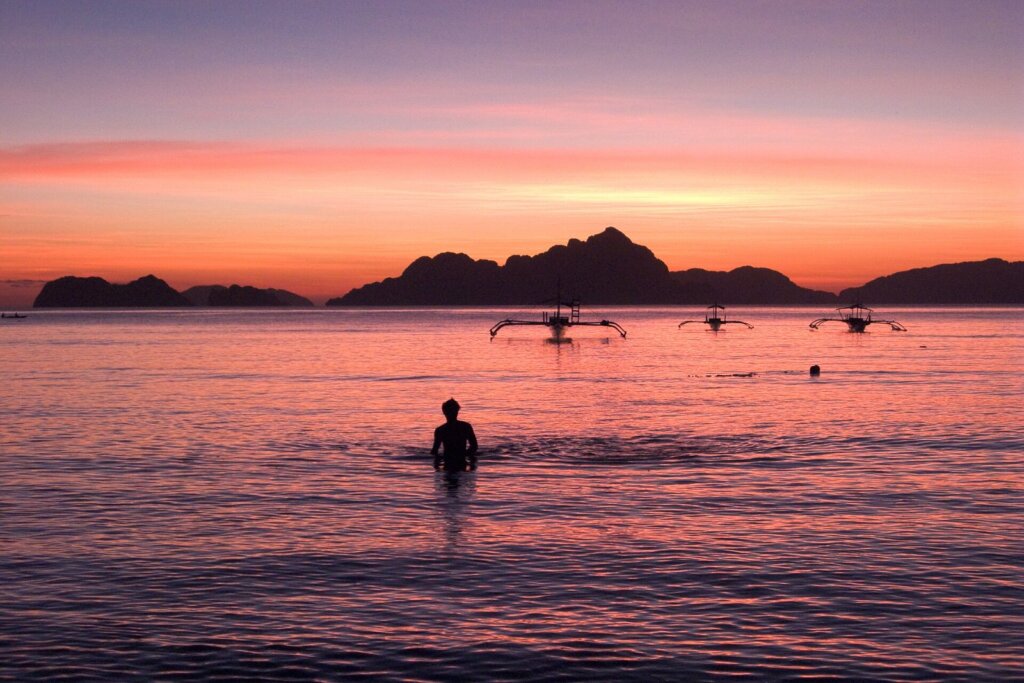
There is also a reframing worth offering. An evening without electricity in El Nido is genuinely pleasant more often than not — restaurants light candles, the constant hum of air conditioning units and generators stops, and on a clear night the sky over Bacuit Bay without street lighting is remarkable. Plenty of visitors end up describing it as the best evening of the trip. It becomes a problem only when it catches you with a dead phone, no cash and a room you cannot sleep in, and all three of those are preventable for the cost of a power bank and a little forethought.
Is It Getting Better?
Slowly, and unevenly. Electrification of off-grid and island areas in the Philippines is overseen by the National Electrification Administration, working through regional electric cooperatives, with national policy set by the Department of Energy. There is active investment in additional generation capacity and in renewable and hybrid systems for Palawan, and several resorts have installed substantial solar arrays of their own.
But tourism demand keeps growing, and the underlying constraint — an isolated island grid dependent on imported diesel — has not gone away. The honest expectation for a visitor planning a trip in the near term is that brownouts remain a normal part of staying in El Nido, not an anomaly worth complaining to your hotel about.
Frequently Asked Questions
How often do power cuts happen in El Nido?
Frequently enough that most visitors staying several nights will experience at least one. There is no fixed schedule for unplanned interruptions, though they cluster around the evening demand peak. Longer scheduled maintenance outages are announced in advance and usually fall on weekdays.
Will my hotel have a generator?
It depends entirely on the price bracket. Upper-tier resorts almost always do, with seamless switchover. Mid-range hotels often have partial coverage that excludes room air conditioning. Budget guesthouses frequently have none. Ask specifically whether the generator powers room air conditioning, not just whether one exists.
Do power cuts affect island hopping tours?
No. Boat tours run on outboard motors and are independent of the town’s electricity supply. Tours are cancelled for weather and sea conditions, never for brownouts.
What should I pack because of this?
A power bank, a small torch or headlamp, offline maps and downloaded booking confirmations, and enough cash for a couple of days. That covers almost every practical problem an outage creates.
Why is it called a brownout if the power goes off completely?
It is simply the standard Filipino English term for any power interruption, used regardless of whether it is a partial voltage reduction or a full outage. If someone tells you there is a brownout, assume the power is off.
Is the electricity situation improving?
Gradually, with ongoing investment in generation capacity and hybrid renewable systems for Palawan. But demand is growing alongside it and the grid remains isolated, so visitors should still plan for interruptions rather than assume they have been solved.