
Scuba Diving for Beginners in El Nido 2026: Try Dives, Courses & First-Timer Tips
You’ve never scuba dived before, but you’re heading to El Nido — one of the Philippines’ premier diving destinations — and you’re curious. Can you dive without certification? How safe is it? What will you see? How much does it cost? This guide answers every question a first-time diver has about getting underwater in El Nido, from a quick try dive to earning your full Open Water certification.
- Do You Need Certification to Dive in El Nido?
- What Is a Discover Scuba Dive (Try Dive)?
- Best Beginner Dive Sites in El Nido
- Try Dive Costs in El Nido 2026
- Should You Do a Try Dive or Get Certified?
- What to Expect: Your First Dive in El Nido
- Choosing a Dive Operator for Your First Dive
- Health Considerations for First-Time Divers
- Related Guides
Do You Need Certification to Dive in El Nido?
No — not for your first experience. Every reputable dive shop in El Nido offers a Discover Scuba Diving (DSD) program, also known as a “try dive” or “intro dive.” This is a supervised introductory experience that requires no prior certification or experience. After a briefing and shallow-water practice session, you descend to a maximum of 12 meters with a divemaster directly at your side throughout the dive.
For certified divers (Open Water and above), the standard fun dive program applies — you can dive independently with a divemaster guide to 18–30m depending on your certification level.
What Is a Discover Scuba Dive (Try Dive)?
A Discover Scuba Diving session typically runs 2.5–3 hours from start to finish and follows this structure:
- Classroom/briefing (30 min): The instructor explains how scuba gear works, the hand signals you’ll use underwater, and the three core safety rules (breathe continuously, equalize your ears as you descend, ascend slowly). No exam — just a short Q&A.
- Shallow water practice (20–30 min): You’ll put on gear and practice in 1–2m of water or in a swimming pool. You’ll learn to breathe through the regulator, clear your mask if it floods, and signal the instructor.
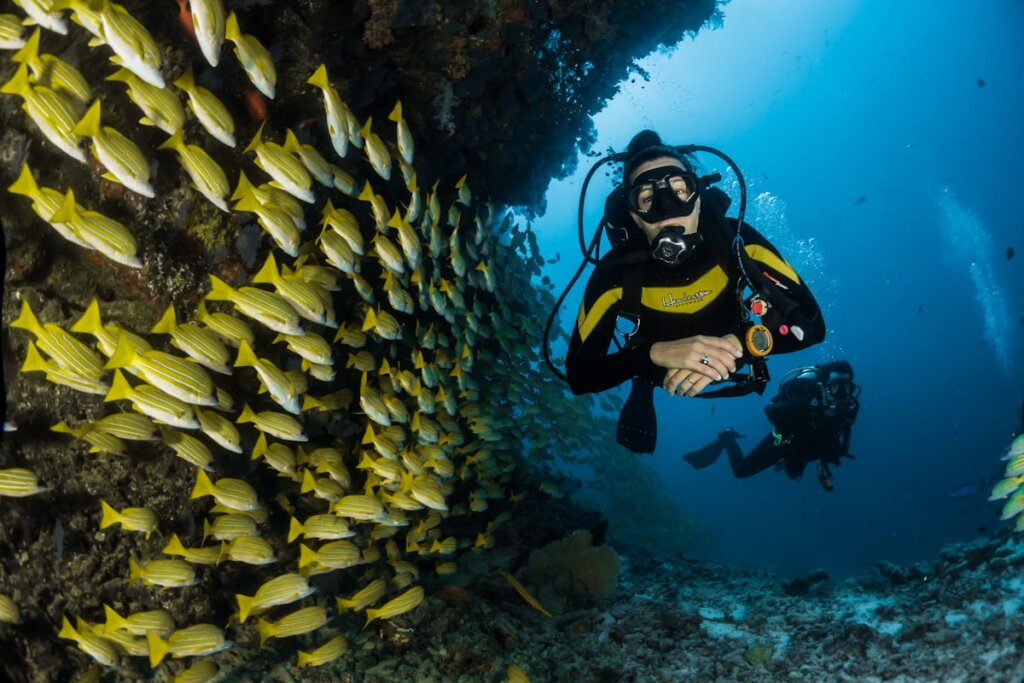
- The dive (30–45 min): You descend to 5–12m at a beginner-friendly site with the divemaster holding your hand or arm throughout. You’ll see real reef, real fish, and real coral — this is not a tank experience.
- Debrief & photos: Instructors often take underwater photos for you. A debrief covers what you saw and whether you’d like to progress to a full certification.
Common Concerns (Answered)
- “I’m not a strong swimmer.” You don’t need to be — buoyancy is controlled by your BCD (vest), not by swimming. You should be comfortable in water, but Olympic swimming ability is irrelevant.
- “I’m claustrophobic.” Open-water diving is actually less enclosed than most people expect — you’re in open ocean, not a cave. Many claustrophobic individuals dive comfortably. Discuss your concerns with the instructor beforehand.
- “My ears hurt when I descend.” This is normal and solved by equalizing — pinching your nose gently and blowing softly as you descend, equalizing pressure. The instructor will teach this and will slow or stop your descent if you signal discomfort.
- “I wear glasses.” Prescription dive masks can be rented or purchased. Mention this when booking.
Best Beginner Dive Sites in El Nido
1. Lagen Island House Reef
Depth: 5–15m | Conditions: Calm, sheltered bay
The sheltered bay fronting Lagen Island Resort is one of El Nido’s calmest and most accessible dive sites — protected from wind and current, with excellent visibility. Sea turtles are sighted here almost daily. Ideal for first dives and Open Water certification confined water sessions.
2. Miniloc House Reef
Depth: 3–12m | Conditions: Very calm, protected lagoon
The sheltered lagoon around Miniloc Island Resort is exceptionally calm — essentially a natural swimming pool with a vibrant coral garden floor. Current is minimal, visibility is excellent, and the stunning karst scenery above water makes the surface intervals as scenic as the dives themselves.
3. Seven Commandos Beach Reef
Depth: 5–14m | Conditions: Gentle, clear
A classic beginner and snorkeler’s reef with gently sloping terrain, abundant reef fish, and reliable good visibility. Accessible from town-based dive operators by bangka in about 30 minutes.
4. Helicopter Island Reef (shallow section)
Depth: 3–10m | Conditions: Moderate — light current possible
The shallower eastern side of Helicopter Island is excellent for beginners — colourful hard coral gardens, frequent turtle sightings, and good fish diversity. The deeper western wall (12–25m) is better suited for certified divers.
Try Dive Costs in El Nido 2026
| Experience | Price Range | What’s Included |
|---|---|---|
| Discover Scuba Dive (1 dive) | ₱3,000–₱4,500 | Briefing, shallow water practice, 1 guided dive, gear, divemaster |
| Discover Scuba Dive (2 dives) | ₱5,000–₱7,000 | As above + second dive at a different site |
| PADI Open Water Course (4 days) | ₱18,000–₱25,000 | Full certification: theory, confined water, 4 open water dives |
| PADI Advanced Open Water (2 days) | ₱12,000–₱16,000 | Requires Open Water cert; 5 adventure dives including deep + navigation |
| PADI Rescue Diver | ₱16,000–₱22,000 | Requires Advanced cert; most safety-focused recreational cert |
Note: Equipment rental is typically included in all packages above. Dive log books, PADI materials, and certification cards may be extra for courses (₱2,000–₱4,000).
Should You Do a Try Dive or Get Certified?
Choose a Try Dive If:
- You have only 1–2 days available for diving activities
- You’re unsure whether you’ll enjoy scuba diving
- You’re primarily visiting El Nido for island hopping and diving is a secondary interest
- Budget is a consideration
Get Certified (PADI Open Water) If:
- You have 4+ days available
- You plan to dive on future trips (certification is lifetime, valid worldwide)
- You want to access deeper sites and go without a hand-holding divemaster
- You want to experience El Nido’s outer reef walls, shark sites, and deeper coral gardens
El Nido is an excellent place to get certified — the warm water (27–29°C), outstanding visibility, calm conditions at beginner sites, and spectacular marine life make the learning process genuinely enjoyable rather than just functional.
What to Expect: Your First Dive in El Nido
The Sensation
Many first-time divers report the same feeling: the moment you get your buoyancy right and hover weightlessly above the reef, time stops. Breathing slows. The noise of the world above disappears. What remains is the crackle of parrotfish feeding on coral, the movement of light through water, and an enormous, alien world a few meters below the surface you’ve been swimming above for years. For many people, the first dive is life-changing.
Common First-Timer Experiences
- Ear discomfort: Equalize every meter of descent — don’t rush. Signal the divemaster if it hurts.
- Breathing anxiety: The regulator feels strange at first. Focus on slow, full breaths. Within a few minutes it becomes natural.
- Buoyancy struggles: Expect to bob up and down a bit — this is completely normal and the divemaster will help stabilize you.
- Overwhelm: There’s so much to see that beginners often miss half of it. That’s fine — your second dive will be calmer and you’ll observe more.
Choosing a Dive Operator for Your First Dive
For beginner divers, safety and instructor quality matter more than price. When choosing an operator:
- Verify PADI or SSI affiliation — look for the logo and ask to see current instructor cards
- Ask about the maximum student-to-instructor ratio for try dives (should be 2:1 maximum — ideally 1:1)
- Check that equipment appears well-maintained — BCDs should have no visible damage, regulators should breathe smoothly in the shop
- Read recent reviews specifically from first-time divers on Google or TripAdvisor
- A good instructor will never rush your briefing or skip the shallow water practice session
Recommended Operators for Beginners
- El Nido Resorts Dive Center (Miniloc/Lagen) — premium, conservative safety standards, small groups
- Scandi Divers El Nido — well-reviewed, experienced instructors, good beginner program
- El Nido Adventure Divers — popular with backpackers, accessible pricing for try dives
- North Sea Divers — smaller operation, personalized instruction
Health Considerations for First-Time Divers
Scuba diving has specific medical contraindications. You’ll complete a medical questionnaire (PADI Medical Statement) before your try dive. Conditions that may require a doctor’s clearance or preclude diving include:
- Current or recent respiratory illness (cold, chest infection)
- Asthma (mild, well-controlled asthma may be acceptable — discuss with operator)
- Pregnancy
- Perforated eardrum or recent ear surgery
- Severe cardiovascular conditions
- Epilepsy
If you’re unsure, consult your doctor before arriving in El Nido. Most healthy adults can dive without issue.
Don’t fly within 18 hours of your last dive — reduced air pressure in aircraft can trigger decompression sickness. If you’re flying home from El Nido, plan your last dive day accordingly.
Related Guides
- El Nido Diving Guide: Best Sites, Operators & Prices
- Snorkeling vs Diving in El Nido: Which Should You Choose?
- El Nido Liveaboard Diving Guide
- El Nido Turtle Watching Guide
- El Nido Water Activities Guide
El Nido’s underwater world is genuinely one of the finest on the planet. You don’t need years of experience to access it — just one afternoon, one patient divemaster, and the willingness to breathe slowly and look around. Your first dive in El Nido might be the beginning of a lifelong passion.