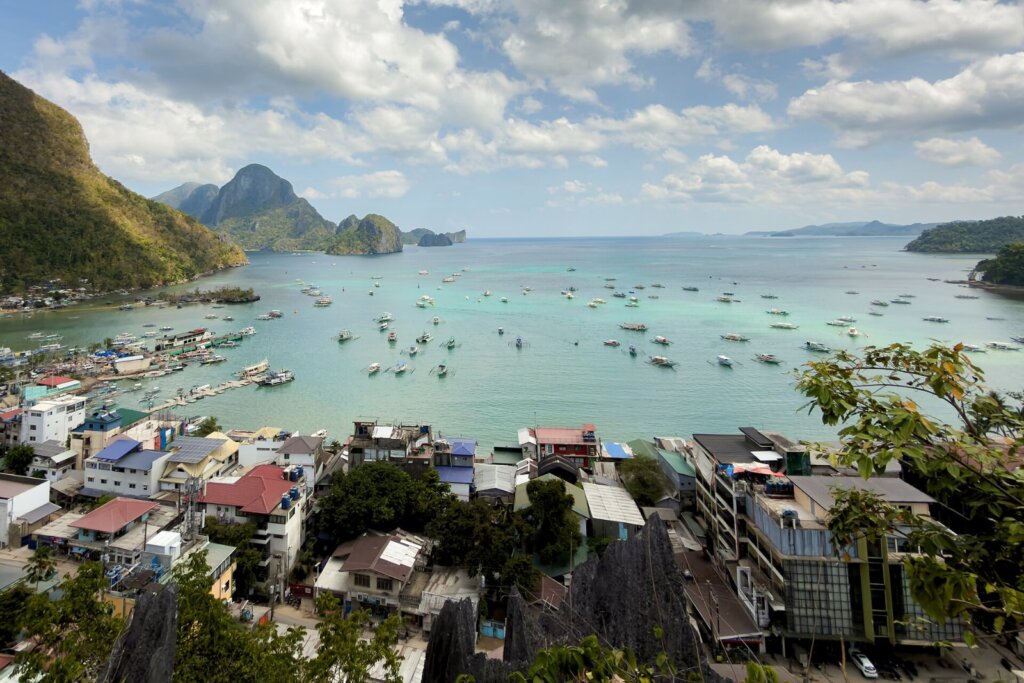

The south-west monsoon (Habagat) arrives in El Nido sometime between late May and mid-June and holds until October. Visitor numbers drop sharply, prices fall to their annual floor, and the landscape transforms — lush green cliffs replace the dry-season dusty tones. Island-hopping tours still run throughout the wet season, but with more cancellations and fewer boats. This guide gives an honest assessment of what the wet season means for your trip.

Table of Contents
Wet Season Overview: June to October
| Month | Rain Level | Sea Conditions | Tours | Crowds | Price |
|---|---|---|---|---|---|
| June | Moderate-heavy | Variable | Reduced schedule | Very low | Cheapest |
| July | Heavy | Often rough | Limited; cancellations | Very low | Cheapest |
| August | Heavy (typhoon risk) | Rough-very rough | Frequent cancellations | Lowest | Cheapest |
| September | Heavy (typhoon risk) | Rough | Frequent cancellations | Very low | Cheapest |
| October | Moderate (easing) | Calming | Improving availability | Low | Very cheap |
The Honest Assessment: Should You Visit in the Wet Season?
The answer depends entirely on your expectations and flexibility.
Visit in the wet season if: You have budget constraints (accommodation 40-60% cheaper than peak), you have schedule flexibility to absorb a 1-3 day tour delay, you appreciate lush green scenery and dramatic cloudy skies over blue-sky cliché shots, or you simply cannot travel any other time.
Avoid the wet season if: Your trip is short (4 days or fewer) and cannot absorb a cancelled tour day. If island-hopping is the primary reason you are visiting El Nido, the wet season carries real risk that you may not get to do all the tours you planned.
The best wet season window is October — the Habagat is weakening, conditions improve rapidly through the month, and prices are still at wet-season lows. Many travellers find October a genuinely good time to visit.
Month-by-Month Breakdown
June: Monsoon Arrives
June is the transition month. The south-west monsoon typically establishes itself in El Nido in the first or second week of June (exact timing varies by year). The first 1-2 weeks of June often still have reasonable conditions; by mid-to-late June the Habagat is usually fully arrived.
- Tour cancellation risk: moderate in early June, higher in late June
- Accommodation prices: drop sharply from May levels once rain establishes
- Scenery: waterfalls begin flowing; jungle vibrancy building
- Best strategy: Target the first 10 days of June for wet-season prices with near-dry-season conditions (year permitting)
July-August: Peak Wet Season
July and August are El Nido’s wettest months. The Habagat brings consistent south-west swells, multi-day rain episodes, and the highest typhoon risk of the year. Tour cancellations of 2-4 consecutive days are possible. Some island-hopping operators reduce their schedule to 3-4 days per week.
- Typhoon risk: The Philippines typhoon season peaks July-October. Direct hits on Palawan are less common than the eastern seaboard (Visayas, Luzon) but not impossible. Check PAGASA forecasts before travel
- Visibility: 3-8 m at most snorkel sites — the freshwater runoff from rain significantly reduces underwater clarity
- Tours available: Tour D (Cadlao Lagoon, sheltered) is the most reliable; Tour C (Helicopter Island, open water) most likely to cancel
- Compensation: Accommodation rates are 40-60% below peak; the lagoons on clear days are stunning with lush green cliffs and almost no other boats
September: Still Wet, Slightly Improving
September shares July-August characteristics but with a gradual improvement toward the end of the month. Later September can produce several consecutive clear days. The typhoon risk remains elevated. This is still firmly the off-season — primarily visited by budget travellers, long-stay digital nomads, and diving enthusiasts who know the underwater landscape well enough to dive in reduced visibility.
October: The Wet Season Sweet Spot
October is when the wet season starts to release its grip. The Habagat weakens, clear days become more frequent, and by late October the Amihan north-east wind is beginning to establish. Tour availability improves significantly through October, and by late October, conditions approach early dry-season standards.
- Early October: still variable, cancellations possible
- Mid-October: conditions improving; most tours running most days
- Late October: approaching November quality; prices still at wet-season floor
- Best wet-season value: late October offers near-dry-season conditions at wet-season prices
Wet Season Prices
| Category | June-October Price | vs December peak | vs November |
|---|---|---|---|
| Budget hostel | 400-700 PHP/night | -50-60% | -15-25% |
| Mid-range hotel | 1,200-2,500 PHP/night | -55-65% | -20-30% |
| Boutique hotel | 2,500-5,000 PHP/night | -50-65% | -20-30% |
| AirSWIFT flight (Manila) | 2,500-5,000 PHP | -50-65% | -25-35% |
| Island-hopping tour | 1,200-1,500 PHP | -15-20% | -10% |
| Restaurant meals | Similar or slightly cheaper | -10-15% | Similar |
The wet season represents the biggest savings opportunity in the El Nido calendar. A 7-day mid-range trip in August can cost 35-50% less than the same trip in December. The trade-off is real — but for flexible budget travellers, the savings are substantial.
Island-Hopping in the Wet Season
Tours operate throughout the wet season but with important differences:
- Tour D (Cadlao Lagoon) — most reliable. Cadlao Island’s sheltered western coast is protected from Habagat south-west swells. Cadlao Lagoon is calm even when outer bay tours cancel. Strongly recommended as your first booking in any wet-season trip
- Tour B (Snake Island, Cathedral Cave) — runs in moderate conditions; Cathedral Cave and Snake Island sandbar are more sheltered than Tour A and C stops
- Tour A (Big Lagoon, Small Lagoon) — the lagoon entrance can be rough in Habagat conditions. Tours run on calmer days but cancel more frequently than D or B
- Tour C (Helicopter Island, Tapiutan Strait) — the most exposed tour; highest cancellation rate in wet season. The open-water crossing to Helicopter Island is directly into the south-west swell
Booking strategy for wet season: Do not pre-book multiple tours in advance — assess conditions daily and book the morning you go. The flexibility to take a tour on the best-weather day of your visit is the most valuable thing you can do in the wet season.
What the Wet Season Does Well
Lush Scenery
The limestone karsts in wet season are covered in vivid, saturated green vegetation — waterfalls appear on cliff faces that are dry for seven months of the year. When the sun breaks through between showers, the combination of green cliffs, turquoise water, and dramatic cloud formations creates some of El Nido’s most photogenic moments.
Empty Lagoons
On the calm days that occur throughout the wet season, the lagoons at Big Lagoon, Small Lagoon, and Cadlao Lagoon are almost completely empty. There is no experience quite like paddling a kayak alone through Big Lagoon in July — an experience that is simply impossible in December when 15 tour boats arrive simultaneously.
Firefly Tours
The mangrove firefly tours (evening, departs ~5:30 PM) are spectacular during the wet season. Firefly populations peak after the rains, and the mangrove vegetation is thickest and most vibrant. This is one wet-season activity that is genuinely better than in the dry season.
Practical Tips for Wet Season Visitors
- Build in buffer days — for a 5-day trip with 3 tour days planned, assume 1 day will be cancelled and plan accordingly. Book 1 extra night as a contingency buffer
- Pack a quality rain jacket — a packable, waterproof jacket is essential. Budget 15-minute showers will not justify it; full-day rain episodes will
- Book flexible accommodation — wet season operators typically accept day-before cancellations on tours; your accommodation should allow 24-hour cancellation too
- Watch PAGASA typhoon forecasts — the Philippine weather agency (pagasa.dost.gov.ph) issues reliable 5-day forecasts. Check daily from 5 days before arrival
- Tour D first, always — in any doubtful weather, Tour D (Cadlao Lagoon) is the most sheltered and most likely to run. Do not save it for last
- Nacpan Beach is excellent in wet season — the beach itself is dramatic in stormy light, and the monsoon surf (too rough for swimming) creates spectacular wave photography conditions
Frequently Asked Questions
Can you go to El Nido in the rainy season?
Yes — El Nido is open year-round and island-hopping tours operate throughout the wet season with reduced schedules. The key requirement is flexibility: some tour days will be cancelled, and your itinerary needs to accommodate that. For travellers with 7+ days and budget flexibility, the wet season is entirely viable. For short 3-4 day trips where every day matters, the dry season (November-May) is strongly recommended.
Which is the worst month in El Nido?
July, August, and September see the most rain, roughest seas, and highest typhoon risk. Of these, August is statistically the wettest month with the most tour cancellations. However, even August can produce several consecutive clear days — it is not continuously rainy, just unpredictable. October improves significantly and is a reasonable month to visit.
Is El Nido affected by typhoons?
Palawan sits to the west of the Philippine typhoon belt and receives fewer direct hits than the Visayas or eastern Luzon. However, typhoon impacts are not impossible, particularly from July-October. Glancing impacts bring heavy rain and rough seas even without a direct strike. Travel insurance covering typhoon-related cancellations is strongly recommended for wet-season travel.
What is the best month to avoid crowds in El Nido?
For the lowest crowds with acceptable conditions: November (dry season just starting, prices at low-season floor, good weather from mid-month) or late October (wet season ending, prices still low). For the absolute fewest tourists regardless of conditions: July-September, but at the cost of reliable tour access.
Complete Seasonal Guide Links
Explore the full monthly guide series: November (best value) · December (peak) · January · February (mantas) · March (best value dry) · April (Holy Week) · May (last dry month) · Full best time to visit guide
| Platform | Best For | El Nido Deals |
|---|---|---|
| Booking.com | Hotels, resorts, free cancellation | View deals → |
| Agoda | Best Asia prices, loyalty rewards | View deals → |
| Klook | Tours & activities | Browse tours → |