
Most El Nido island hopping guides tell you which tour to book. Almost none tell you where to sit once you step onto the boat, yet that one decision shapes your entire day: whether you stay dry, whether you get seasick, whether your camera survives, and whether you spend six hours in full sun or comfortable shade. This guide focuses on seat choice specifically for first-time island hoppers on shared Tour A, B, C and D boats, plus a few notes for private charters.
The unique angle here is simple: we treat the traditional outrigger bangka as a small piece of real estate. Every zone has trade-offs, and the “best” seat changes depending on wind direction, the time of year, and what you personally care about most. Read this before your tour, and you will be the person on board who looks like they have done it ten times.
How an El Nido Island Hopping Boat Is Laid Out
The standard tour boat in Bacuit Bay is a motorized bangka, a long, narrow wooden or fibreglass hull stabilised by bamboo or PVC outriggers on both sides. Shared tour boats typically carry somewhere between 15 and 30 guests plus a crew of three to five. The layout is very consistent across operators:
- The bow (front): an open deck, often with a ladder or gangplank used for boarding on beaches. No roof.
- The main cabin: two long benches running along each side under a fixed canopy, facing inward or outward. This is where most guests sit.
- The midships section: the area just in front of and around the engine housing, usually the most stable part of the boat.
- The stern (back): the crew zone, the engine, the cooler boxes, and often the kitchen area where lunch is grilled.
- The roof: on some boats, guests are allowed up top. On many it is crew-only, and you should always ask first.
Once you can picture these five zones, you can choose deliberately instead of grabbing whichever spot is empty.
Seat-by-Seat Comparison Table
Here is a quick reference you can screenshot before you board. Ratings reflect a typical dry-season day with light to moderate chop.
| Seat zone | Spray risk | Motion (seasickness) | Shade | Views and photos | Best for |
|---|---|---|---|---|---|
| Bow / front deck | High | Highest | None | Excellent | Photographers, thrill seekers on calm days |
| Front of cabin (first two rows) | Medium to high | High | Good | Very good | People who want views with some shade |
| Midships cabin | Low | Lowest | Excellent | Good | Anyone prone to seasickness, families, older travellers |
| Rear cabin near engine | Low | Low | Good | Moderate | Calm stomachs, people who like the lunch prep action |
| Outer edge of bench | Medium | Same as row | Partial | Very good | Quick access to the water and ladder |
| Roof (if allowed) | Low | High | None | Excellent | Short hops on calm days only |
Choosing a Seat by Priority
Every seat is a compromise. Pick the one priority that matters most to you today, then use the matching advice below.
If You Get Seasick: Sit Midships, Low and Facing Forward
Motion is smallest near a boat’s centre of rotation, which on a bangka is roughly the middle of the hull, slightly toward the stern because of the engine weight. The bow rises and falls the most as it meets each wave. If you are even slightly prone to nausea, claim a spot in the middle third of the cabin, as low as possible, and face the direction of travel so your eyes can watch the horizon.
The CDC’s travel guidance on motion sickness backs the same principles: reduce motion by choosing the most stable position, keep your eyes on a fixed horizon, and avoid reading or staring at your phone. Our dedicated guide on how to avoid seasickness on El Nido boat tours covers medication timing and what to eat beforehand.
A practical tip: the longest open-water legs usually come on Tour C and on any route crossing toward the outer islands, so the midships seat matters more on those days. Compare the routes in our Tour C vs Tour D comparison if you are deciding which day to brave.
If You Want Photos: The Bow and the Front Rows
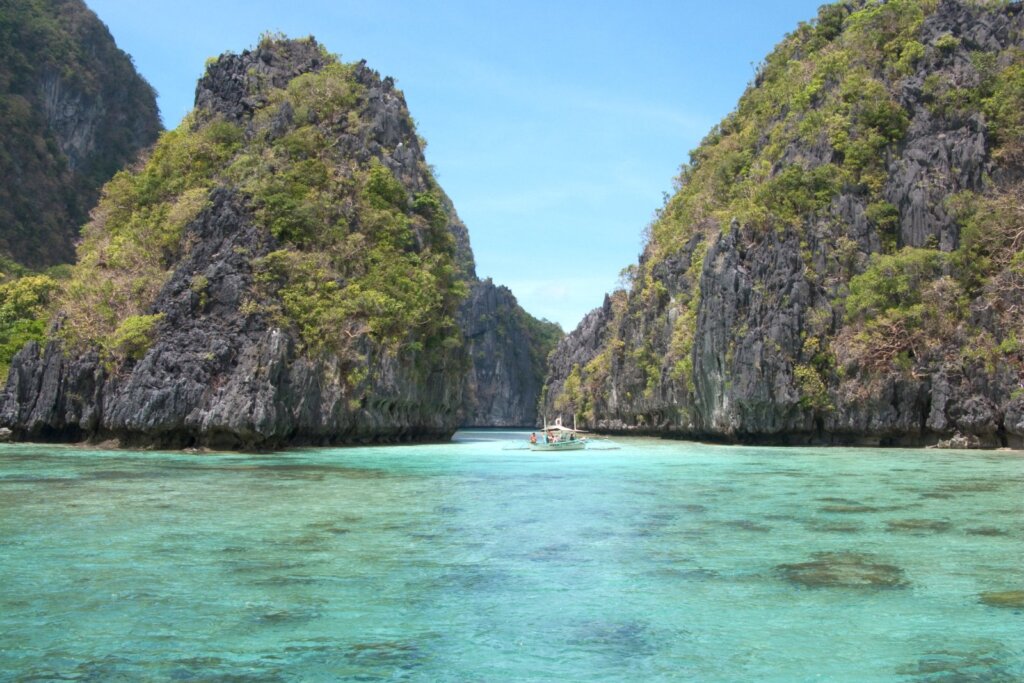
For unobstructed shots of limestone karsts rising out of the water, nothing beats the bow. The canopy cuts off the top of the frame from inside the cabin, and the outriggers and other passengers clutter side views. The front row of the cabin is a decent compromise: you can step forward for a shot as you approach each island, then retreat into the shade.
The trade-off is spray. When the boat punches into a headwind, the front gets wet, sometimes thoroughly. Keep phones in a pouch and cameras in a dry bag until the boat slows down near a stop. Our guide to underwater photography in El Nido has gear suggestions, and the boat tour packing list covers dry bags in detail.
The best light for karst photos is early morning and late afternoon, so the bow is most rewarding on the first and last legs of the tour. Around midday, the flat overhead light and the full sun make it far less appealing.
If You Want to Stay Dry: Middle Rows, Inner Bench, Away From the Windward Side
Spray comes from two places: the bow wave and wind-blown chop hitting the side of the hull. To stay dry, avoid the front of the boat and also avoid the side the wind is coming from. In El Nido, the prevailing wind pattern shifts with the seasons. From roughly December to March, the northeast amihan dominates, while from around June to September the southwest habagat brings stronger and wetter conditions. You do not need to memorise this; simply look at which side of the bay has whitecaps, or ask the boatman which side gets wet today. They always know.
Once you know the windward side, sit on the opposite bench and toward the middle of the boat. Pack valuables inside a bag that sits on your lap or under the bench on the dry side.
If You Want Shade: Under the Canopy, Not on the Edges
Island hopping days are long, often from around 9:00 to 16:00, and much of that time is spent moving across open water with intense reflected light. The World Health Organization notes that water and sand reflect a meaningful portion of UV radiation, which is why people burn on boats even when sitting in the shade.
For maximum shade, sit in the inner half of the bench in the middle of the cabin. The edge seats get direct sun as the boat turns. Reapply sunscreen at every stop and see our El Nido sunburn and UV guide for monthly UV levels. If you use sunscreen, choose a reef-friendly formula, as explained in our reef-safe sunscreen guide.
How to Actually Get the Seat You Want
On shared tours, seats are first come, first served. A few tactics help:
- Arrive early at the meeting point. Groups that arrive ten minutes early are usually first onto the boat. Boarding from the beach often happens via a short wade, so wear water shoes; we compared options in water shoes vs sandals vs reef booties.
- Board with intent. Know which zone you want before stepping aboard. Hesitating on the gangplank is how you end up on the bow with no hat.
- Use the stops to swap. After the first lagoon or beach stop, people return in a different order. If you started in a bad spot, be ready to move.
- Ask the crew. Boatmen redistribute weight to keep the boat level. If you explain you get seasick, they will often find you a midships spot.
- Consider a private charter. If seat politics stress you out, a private bangka lets you move freely all day. See how to book a private boat charter.
Safety Notes Every Passenger Should Know
Seat choice is also about safety. A few rules worth following:
- Do not sit on the outriggers or the bamboo arms unless the crew explicitly invites you to while the boat is stationary. They are not designed to carry passenger weight while moving.
- Know where the life jackets are. They are usually stored under benches or in the roof canopy. The Philippine Coast Guard regulates passenger vessels and inspects boats for safety equipment, and a reputable operator will point them out.
- Keep the gangways clear. Bags piled in the aisle are a trip hazard when the boat rolls.
- Stay seated when underway. Standing at the bow for a photo is common on calm days, but sit down if the boatman signals or the chop increases.
- Weather calls are final. If the Coast Guard or the municipal tourism office suspends tours, no seat makes the trip worthwhile.
Seat Strategy by Tour
Each standard route has a slightly different rhythm, which changes the ideal seat:
- Tour A (lagoons on Miniloc and nearby): short hops in sheltered water. A front-row seat for photos is a safe bet. Read Tour A vs Tour B for the full route breakdown.
- Tour B (caves and Snake Island sandbar): moderate distances with some open water heading south. Midships for sensitive stomachs; bow for the sandbar approach.
- Tour C (hidden beaches and Matinloc): the longest and most exposed legs. Sit midships and on the leeward side.
- Tour D (Cadlao and nearby islands): generally calmer and close to town, so it is a good day to try the bow.
Frequently Asked Questions
Which seat is best on an El Nido island hopping boat?
For most people, the middle of the cabin under the canopy is the best all-round seat. It has the least motion, the least spray and the most shade. Photographers may prefer the front rows or the bow on calm days.
Where should I sit if I get seasick on a bangka?
Sit midships, as low as possible, facing forward with your eyes on the horizon. Avoid the bow and avoid looking at your phone during open-water crossings.
Can I sit on the roof of the boat in El Nido?
Only if the crew allows it. Some boats permit guests on the roof during calm conditions, but many do not, and you should always sit down immediately if the boatman asks.
Will my bag get wet on an island hopping tour?
Possibly, especially near the bow or on the windward side. Use a dry bag, keep it on the leeward bench, and avoid storing it on the open front deck.
Are seats assigned on shared El Nido tours?
No. Seats on shared tours are first come, first served, and people often swap at each stop. Arriving early at the meeting point is the simplest way to secure your preferred zone.
Final Word
Picking a seat sounds trivial until you spend six hours in the wrong one. Decide what matters most to you, whether that is a calm stomach, dry gear, shade or photos, then board with a plan. Combine this with a good packing list and a sensible tour choice and your island hopping day in Bacuit Bay will be as comfortable as it is spectacular.