
TL;DR: Giant clams are protected reef animals you can still spot while snorkeling in El Nido’s Bacuit Bay, mostly the small, neon-mantled boring clam (Tridacna crocea) and the fluted Tridacna maxima. Look for a wavy, glowing “lip” set into coral heads, keep at least an arm’s length away, never touch or stand on them, and never buy shells.
Most El Nido snorkelers come back talking about lagoons, limestone cliffs and turtles. Fewer realise they have probably floated over one of the reef’s most remarkable residents: the giant clam. Their mantles glow electric blue, green, gold and purple, they farm algae inside their own tissue like solar panels, and some species can live for decades. They are also among the most over-harvested animals in Philippine waters, which is why every sighting matters.
This guide focuses on giant clams specifically for snorkelers and first-time island hoppers in El Nido who want to recognise the different species, know where to look on a normal group tour, and follow the etiquette that keeps these animals alive. It is not a dive manual or a biology textbook, it is the field guide we wish we had on our first Tour C.
- What Exactly Is a Giant Clam?
- Giant Clam Species You Might See in El Nido
- Where to Look During Island Hopping
- How to Spot a Giant Clam: A Snorkeler’s Technique
- Giant Clam Etiquette and the Law
- Restoration: Why Giant Clams Are Coming Back
- Photographing Giant Clams Responsibly
- Key Takeaways
- Frequently Asked Questions
What Exactly Is a Giant Clam?
“Giant clam” is the common name for a small group of large marine bivalves in the genera Tridacna and Hippopus. Worldwide there are roughly a dozen recognised species, and the Philippines hosts more of them than almost anywhere else, which makes Palawan’s reefs a natural place to look. You can read a good scientific overview on the giant clam Wikipedia entry.
What makes them unusual is their partnership with microscopic algae called zooxanthellae, the same symbiotic algae that power reef-building corals. The algae live in the clam’s mantle, the fleshy, colourful tissue you see between the shell edges. The clam opens up during the day to give its algae sunlight, and the algae return the favour with sugars. That is why giant clams sit in clear, shallow, sunny water and why they shut slowly when your shadow passes over them: they react to sudden changes in light.
Three facts worth knowing before you get in the water:
- They cannot “trap” swimmers. The old movie myth of a diver caught by a giant clam is just that. Shells close slowly and the animals are not aggressive.
- They are long-lived and slow to recover. Large individuals may be decades old, and populations that were stripped for meat, shells and the aquarium trade take a very long time to rebuild.
- They are filters and reef builders. Clams filter water and their shells provide surfaces for other organisms, so a healthy clam population is a sign of a healthy reef.
Giant Clam Species You Might See in El Nido
You will not see every species on one trip. Larger species were heavily harvested across the Philippines over the last century, so the clams you are most likely to find on El Nido’s shallow reefs are the smaller, coral-boring types. Use the table below to put a name to what you see.
| Species | Typical size | How to recognise it | Where it sits | Chance of seeing it on a group tour |
|---|---|---|---|---|
| Boring / crocus clam (Tridacna crocea) | Up to about 15 cm | Only the brilliant mantle shows; shell is buried in coral | Embedded in coral heads and boulders, very shallow | Good |
| Small giant clam (Tridacna maxima) | Around 20–35 cm | Elongated shell with close-set flutes; patterned mantle | Partly embedded in reef tops | Good |
| Fluted / scaly clam (Tridacna squamosa) | Up to about 40 cm | Big, leaf-like scales on the shell ridges; mottled mantle | Sits freely on reef, often in slightly deeper water | Fair |
| Strawberry / horse’s hoof clam (Hippopus hippopus) | Up to about 40 cm | Heavy zig-zag shell with reddish blotches; mantle barely extends | Sand and seagrass beside reefs | Occasional |
| Smooth giant clam (Tridacna derasa) | Up to about 60 cm | Smooth, heavy shell without scales | Outer reef slopes | Rare |
| True giant clam (Tridacna gigas) | Can exceed 1 m | Huge, deeply folded shell; olive-brown mantle | Usually restocking sites; very rare in the wild | Very rare |
If you only remember one thing: in El Nido, the “giant” clam you meet will usually be a hand-sized boring clam set into coral, glowing like a neon wave. Size does not make it any less special.
Where to Look During Island Hopping
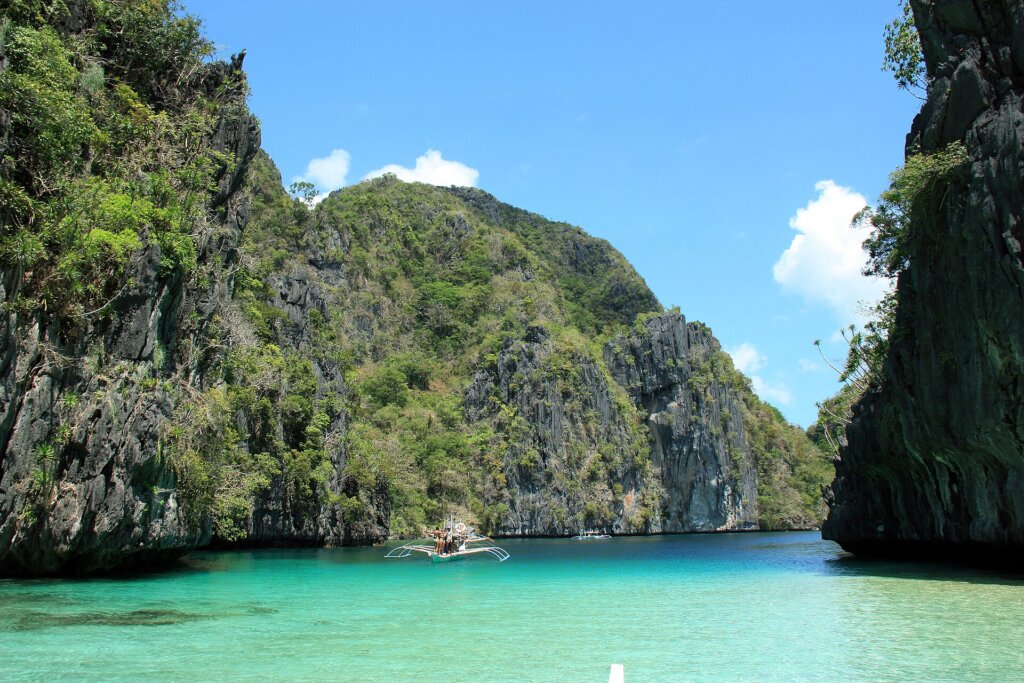
Giant clams need three things: clear water, sunlight and hard substrate. In El Nido that means the fringing reefs and coral gardens around Bacuit Bay’s islands rather than the lagoons themselves, which are often sandy or rocky with less live coral.
- Snorkel stops with coral gardens. Tours that include dedicated snorkelling stops, especially the reef-focused Tour C and the shallow coral areas visited on Tour A, give you the best odds. Ask your boat crew which stop has the “most coral” that day.
- Reef flats at mid to high tide. Many boring clams live in water only one to three metres deep. Mid to high tide lets you float above them without kicking the reef. Our guide to seagrass, turtles and dugongs explains how tides change shallow snorkelling.
- Coral boulders with sunlit tops. Scan the tops and upper sides of rounded coral heads. Clams favour spots that get light most of the day.
- Edges of seagrass beds. This is where you might find the sand-dwelling strawberry clam.
Visibility is usually best on calm mornings and during the drier months. If you wear glasses, a prescription mask makes a huge difference when you are trying to spot a 10 cm animal; see our guide to snorkelling with glasses.
How to Spot a Giant Clam: A Snorkeler’s Technique
Boring clams are easy to miss because the shell is hidden. Use this simple routine at every coral stop:
- Float flat and slow. Keep your fins near the surface. Fast swimmers see colour blur; slow swimmers see shapes.
- Look for a wavy line, not a shell. The tell-tale sign is a zig-zag “smile” of colour, often with iridescent spots, sitting flush against the coral.
- Check for the siphon. Look for a small round opening in the mantle. That is the exhalent siphon and confirms you are looking at a clam rather than a coral or sponge.
- Watch the reaction. If your shadow crosses it, the mantle may retract a little. Do not do this deliberately; one accidental flinch is enough to confirm the ID.
- Move on. Hovering over a clam blocks its light. Take your photo and glide away.
Choosing the right mask matters here as well; we compare full-face and classic snorkel masks for clarity and safety, and explain whether to rent or bring your snorkel gear.
Giant Clam Etiquette and the Law
All giant clams are listed under CITES Appendix II, which controls international trade, and several species are assessed as threatened on the IUCN Red List. In the Philippines, the gathering and trade of threatened marine species is restricted under national fisheries law administered by the Bureau of Fisheries and Aquatic Resources (BFAR), and El Nido sits inside a managed protected area with its own visitor rules. Our explainer on El Nido-Taytay protected area rules covers the bigger picture.
In practice, follow these rules every time:
- Never touch, poke or stand on a clam. Mantles are delicate, and touching can introduce bacteria or damage tissue. Standing on a reef also kills the coral the clam is anchored to.
- Keep at least an arm’s length away. More if you are not confident with your buoyancy or fins.
- Do not make them close for a photo. Each forced closure costs the animal energy and feeding time.
- Use reef-friendly sun protection. A rash guard is better than lots of sunscreen in the water.
- Never buy clam shells or clam meat. Polished giant clam shells sometimes appear in souvenir markets around the Philippines. Buying them fuels illegal harvesting and can get you into trouble at customs. See our guide to taking shells and coral home.
Restoration: Why Giant Clams Are Coming Back
The Philippines is home to one of the longest-running giant clam restoration efforts in the world. Scientists at the University of the Philippines Marine Science Institute began breeding giant clams decades ago, producing juveniles in hatcheries and growing them out in ocean nurseries before placing them on protected reefs around the country. Local governments, resorts and community groups have since run their own clam gardens and sanctuaries.
For travellers, this has two implications. First, when you see a very large clam in a neat cluster, it may be part of a restocking programme rather than a wild survivor, which is a good-news story worth respecting. Second, the reefs you snorkel in El Nido are part of an ongoing recovery. Every tourist who keeps their hands off helps that recovery succeed.
If you are curious about how reefs reproduce and rebuild, our article on coral spawning in El Nido pairs well with this one.
Photographing Giant Clams Responsibly
Clam mantles are some of the most photogenic subjects on the reef. A few tips for better pictures without stressing the animal:
- Shoot from slightly above and to the side so you do not cast a shadow straight down on the mantle.
- Get close with your lens, not your body. A wide-angle action camera at 30–50 cm captures plenty of detail.
- Use natural light. In shallow El Nido water you rarely need a strobe, and bright lights can make the clam retract.
- Breathe out slowly before the shot to sink a few centimetres without kicking.
- Limit yourself to a few frames and then move on, especially if other snorkelers are waiting.
Be aware of what else lives on the reef while you focus on photos. Our guide to El Nido reef hazards explains which animals not to put a hand near.
Key Takeaways
- The clams you are most likely to see in El Nido are the small, coral-embedded boring clam and the fluted Tridacna maxima.
- Look on sunlit tops of coral heads in one to three metres of water, ideally on calm mornings at mid to high tide.
- Identify them by a glowing, wavy mantle edge and a round siphon opening.
- Keep an arm’s length away, never touch or stand on them, and never force them to close.
- All giant clams are trade-controlled and protected; never buy shells or meat.
- Reef-focused snorkel stops, often on Tour C and parts of Tour A, give the best chances.
Frequently Asked Questions
Can you see giant clams in El Nido?
Yes. Snorkelers regularly see smaller species such as the boring clam (Tridacna crocea) and Tridacna maxima on shallow coral reefs around Bacuit Bay. The very largest species, Tridacna gigas, is rare in the wild.
Which El Nido island hopping tour is best for giant clams?
Tours with dedicated coral snorkelling stops give the best chance, especially the reef-focused Tour C and the coral areas on Tour A. Conditions change daily, so ask your boat crew which stop has the healthiest coral.
Are giant clams dangerous to snorkelers?
No. Giant clams close slowly, are not aggressive and cannot trap a swimmer. The real risk is to the clam, which can be injured by touching, standing or kicking.
Is it legal to buy giant clam shells in the Philippines?
Giant clams are protected and listed under CITES Appendix II. Buying, selling or exporting shells or meat without permits can be illegal, so avoid any souvenir made from clam shell.
Why do giant clams close when I swim over them?
They react to sudden changes in light. Your shadow looks like a potential predator, so the clam retracts its mantle. Avoid hovering directly above them.
What colour are giant clams?
Mantle colours range from electric blue and turquoise to green, gold, brown and purple, often with iridescent spots. Colour comes from pigments and the symbiotic algae living in the tissue.
About the Author
This guide was compiled by the El Nido Hotels Ranking editorial team, with input from local operators and ongoing on-the-ground updates.