
TL;DR: On a typical El Nido snorkel stop you can expect to see clownfish, parrotfish, butterflyfish, Moorish idols and sergeant fish, with rays, lionfish and trevally on richer reefs. Learn the 12 species below, keep your distance and never touch or feed marine life.
Most visitors to El Nido spend hours in the water during island-hopping tours, yet very few can name what they are looking at. Knowing a handful of reef fish turns a pretty swim into a treasure hunt, helps you spot the less obvious animals, and makes it easier to describe what you saw to your guide or dive instructor.
This guide focuses on reef fish identification specifically for first-time snorkelers on El Nido boat tours who want a simple, practical field guide rather than a scientific checklist. Every species below is widespread in the Indo-Pacific and commonly reported in the reefs of Bacuit Bay, but sightings always vary by site, season and luck. For a broader overview of turtles, rays and other wildlife, see our El Nido marine life guide.
- How to Identify Reef Fish While Snorkeling
- 12 Reef Fish to Look For in El Nido
- 1. Clown Anemonefish (Amphiprion ocellaris)
- 2. Moorish Idol (Zanclus cornutus)
- 3. Parrotfish (family Scaridae)
- 4. Butterflyfish (family Chaetodontidae)
- 5. Emperor Angelfish (Pomacanthus imperator)
- 6. Blue-spotted Ribbontail Ray (Taeniura lymma)
- 7. Batfish (genus Platax)
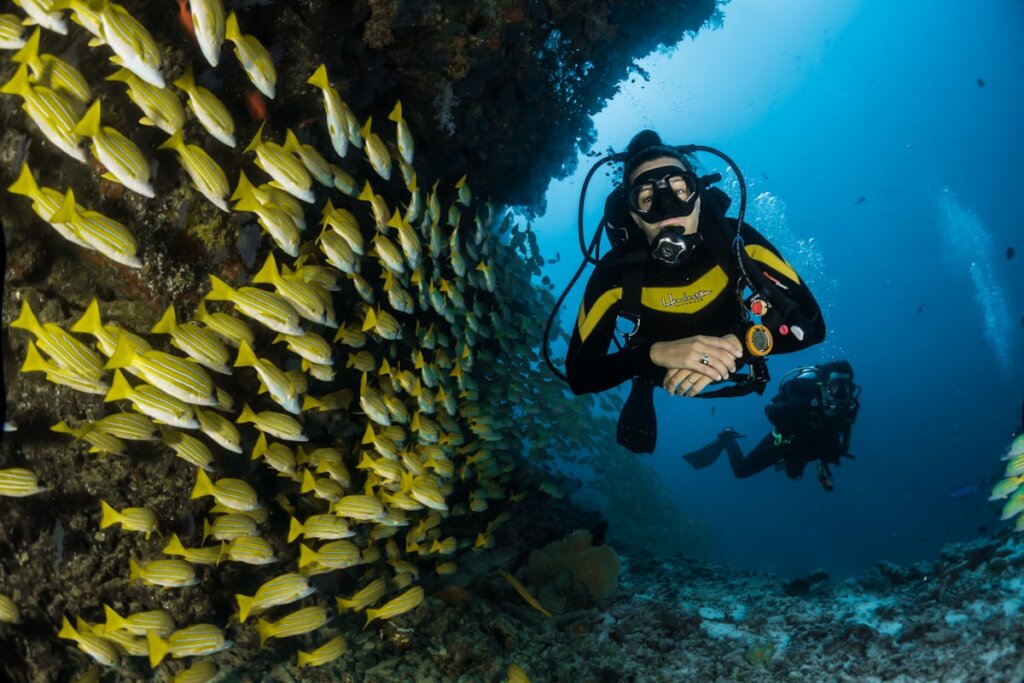
- 8. Indo-Pacific Sergeant (Abudefduf vaigiensis)
- 9. Lionfish (genus Pterois)
- 10. Titan Triggerfish (Balistoides viridescens)
- 11. Pufferfish (family Tetraodontidae)
- 12. Bluefin Trevally (Caranx melampygus)
- Quick ID Comparison Table
- Where You Will See the Most Fish
- Reef Etiquette: Watch Without Harming
- Trusted Resources for Fish ID
- Tips for Photographing Reef Fish
- Key Takeaways
- Frequently Asked Questions
How to Identify Reef Fish While Snorkeling
You do not need a field guide in your hand to start recognizing fish. Instead, train yourself to note four things in the few seconds you see a fish: its body shape (disc, torpedo, oval or flattened), its main colors and patterns (stripes, bars, spots or a mask through the eye), its behavior (schooling, hovering, hiding in coral or picking at sand) and its habitat (anemone, sand patch, reef edge or open water). Those four clues are enough to narrow most sightings to a family, and often to a species.
Float calmly at the surface, breathe slowly and let fish come to you. Splashing scares most species away. A good mask makes a huge difference; our comparison of full-face vs classic snorkel masks helps you choose.
12 Reef Fish to Look For in El Nido
1. Clown Anemonefish (Amphiprion ocellaris)
How to recognize it: Bright orange with three white bands edged in thin black lines. Look inside sea anemones in shallow, sheltered reef; they rarely stray more than a body length from home.
Good to know: They defend their anemone and may dart at your mask. Admire from a distance and never touch the anemone, which can sting and is easily damaged.
2. Moorish Idol (Zanclus cornutus)
How to recognize it: Bold black, white and yellow vertical bands, a long trailing white dorsal filament and a small, pointed snout. Usually seen in pairs or small groups along the reef edge.
Good to know: Often confused with bannerfish, which look similar but have a shorter snout and less yellow.
3. Parrotfish (family Scaridae)
How to recognize it: Large, colorful fish with fused beak-like teeth, often in greens, blues and pinks. Listen for a crunching sound as they bite algae off dead coral.
Good to know: Parrotfish help keep reefs healthy and produce much of the fine sand on tropical beaches. Different sexes and life stages can look completely different.
4. Butterflyfish (family Chaetodontidae)
How to recognize it: Small, flat, disc-shaped fish, usually yellow, white and black, often with a dark band through the eye and a false eyespot near the tail. Frequently seen in pairs.
Good to know: Many species feed on coral polyps, so a reef with lots of butterflyfish is often a sign of healthy live coral.
5. Emperor Angelfish (Pomacanthus imperator)
How to recognize it: Adults have blue and yellow horizontal stripes and a dark mask; juveniles are dark blue with white concentric rings and look like a different species.
Good to know: Often found near overhangs and ledges. They can be shy, so stay still and let them come into view.
6. Blue-spotted Ribbontail Ray (Taeniura lymma)
How to recognize it: A small oval ray with a tan body covered in electric-blue spots and two blue stripes down the tail. Often rests under coral heads or on sand patches.
Good to know: Like all stingrays it has a venomous tail spine. Never touch or crowd one, and shuffle your feet when wading on sandy bottoms.
7. Batfish (genus Platax)
How to recognize it: Tall, silvery, disc-shaped fish that often approach snorkelers out of curiosity, sometimes in small schools near drop-offs and wrecks.
Good to know: Juveniles look very different, often dark with orange edges, and may mimic drifting leaves.
8. Indo-Pacific Sergeant (Abudefduf vaigiensis)
How to recognize it: Small fish with five dark vertical bars on a pale body and a yellow wash on the back. Common in schools around boats and shallow reefs.
Good to know: They are among the most visible fish at busy tour stops. Do not feed them; feeding changes natural behavior and harms reef health.
9. Lionfish (genus Pterois)
How to recognize it: Red-brown and white stripes with long, fan-like fins and spines. Often hovers motionless near crevices and overhangs.
Good to know: Lionfish spines are venomous. Look but keep clear, and never try to handle one.
10. Titan Triggerfish (Balistoides viridescens)
How to recognize it: A large, heavy-bodied fish with a mottled olive pattern and dark “mustache” markings, often seen picking at the sand.
Good to know: During nesting periods they aggressively defend a cone-shaped territory that extends upward. If one charges, swim away horizontally, not upward.
11. Pufferfish (family Tetraodontidae)
How to recognize it: Rounded body, beak-like teeth and large eyes. Species seen in El Nido include map pufferfish and spotted pufferfish, often resting near coral.
Good to know: Never chase or provoke a puffer into inflating; it causes stress and can injure the fish.
12. Bluefin Trevally (Caranx melampygus)
How to recognize it: A fast, streamlined silver fish with electric-blue fins and dark speckles, often hunting along the reef edge alone or in small groups.
Good to know: Trevally are a sign of a productive reef. You will see them most often near channels and drop-offs on deeper tour stops.
Quick ID Comparison Table
| Fish | Key ID feature | Where to look | Caution |
|---|---|---|---|
| Clown anemonefish | Orange with three white bands | Inside anemones, shallow reef | Do not touch anemones |
| Moorish idol | Long white dorsal streamer | Reef edge, in pairs | None |
| Parrotfish | Beak-like teeth, bright colors | Grazing on coral rubble | None |
| Blue-spotted ribbontail ray | Electric-blue spots | Under coral heads, sand | Venomous tail spine |
| Lionfish | Fan-like striped fins | Crevices, overhangs | Venomous spines |
| Titan triggerfish | Large, mottled, dark “mustache” | Sandy areas near reef | Territorial when nesting |
Where You Will See the Most Fish
Fish diversity depends on healthy coral, so the richest snorkeling is usually at protected reef sites rather than the busiest beach stops. Tour itineraries that include reef-focused stops, such as several on Tour C and Tour D, tend to offer more variety; our Tour C vs Tour D comparison shows which stops are mainly beaches and which are mainly reefs. Calm, clear mornings are typically best, and visibility often drops after heavy rain or in strong wind. Check El Nido tide times too: very low tides can make shallow reefs hard to cross without touching coral.
Many species are more active at dawn and dusk, while others, such as lionfish, are easier to spot at night. If you are a certified diver, night diving in El Nido reveals a completely different cast of characters.
Reef Etiquette: Watch Without Harming
El Nido’s reefs fall within a protected area, and every snorkeler has a role in keeping them healthy. Follow these simple rules on every stop:
- Never stand on, kick or touch coral; wear a life vest or buoyancy aid if you are not a confident swimmer.
- Do not feed fish. Bread and other food change behavior and pollute the water.
- Do not chase, grab or corner any animal, especially rays, turtles and pufferfish.
- Use reef-safe sunscreen or a rash guard to reduce chemicals entering the water.
- Take nothing but photos, including shells and dead coral.
Some marine animals can injure you if disturbed. Read our guide to El Nido reef hazards before your first snorkel.
Trusted Resources for Fish ID
If you want to dig deeper after your trip, FishBase is a free global database with species profiles, photos and distribution maps for nearly every fish mentioned here. The Philippines’ DENR Biodiversity Management Bureau publishes information on protected areas and marine biodiversity, and the Coral Triangle Initiative explains why this region, which includes Palawan, holds the highest diversity of reef fish and corals on Earth.
Many travelers also enjoy logging sightings with a free nature app or simply jotting down a list each evening. It is a fun way to involve kids and to remember which stops were the best.
Tips for Photographing Reef Fish
Fish move quickly, so patience matters more than gear. Hover still at the surface, wait for the fish to turn side-on, and shoot slightly upward or level rather than straight down for more natural images. Get close by letting the fish approach rather than swimming at it. Shoot in bright midday light for the best color in shallow water, and keep the sun behind you. If your camera allows, use burst mode and a fast shutter speed. Above all, never rest on coral to steady a shot.
For an even richer experience, combine your fish list with smaller creatures: our macro diving guide covers seahorses and nudibranchs, and giant clam spotting is a highlight at several snorkel stops.
Key Takeaways
- Learn body shape, color pattern, behavior and habitat to identify most reef fish in seconds.
- Clownfish, parrotfish, butterflyfish, Moorish idols and sergeant fish are among the easiest to spot in El Nido.
- Lionfish and rays have venomous spines, and titan triggerfish can be territorial; observe from a distance.
- Reef-focused tour stops and calm mornings typically offer the best fish variety and visibility.
- Never touch, feed or chase marine life, and use reef-safe sunscreen or a rash guard.
Frequently Asked Questions
What fish can you see in El Nido?
Snorkelers commonly see clownfish, parrotfish, butterflyfish, angelfish, Moorish idols, sergeant fish, pufferfish and trevally, plus rays, turtles and occasionally lionfish on healthier reefs.
Is it safe to snorkel with fish in El Nido?
Yes, as long as you do not touch anything. A few species, such as lionfish, rays and stonefish, have venomous spines, and triggerfish may defend nests, so keep a respectful distance.
Where is the best snorkeling for fish in El Nido?
Reef-focused stops on island-hopping tours usually offer the best fish variety. Ask your guide which stops have the healthiest coral that day, as conditions change with weather and season.
Can I feed the fish in El Nido?
No. Feeding fish disrupts natural behavior, can make fish aggressive and harms the reef. Responsible operators discourage it.
Do I need to dive to see reef fish in El Nido?
No. Many of the most colorful reef fish live in shallow water and are easy to see while snorkeling from tour boats.
About the Author
This guide was compiled by the El Nido Hotels Ranking editorial team, with input from local operators and ongoing on-the-ground updates.